

EC-COUNCIL 312-39 Exam Prep Guide: Prep guide for the 312-39 Exam
2026 New Preparation Guide of EC-COUNCIL 312-39 Exam
Obtaining the CSA certification can open up a range of career opportunities for cybersecurity professionals. Employers often look for candidates with advanced certifications like the CSA when hiring for roles such as Security Operations Center (SOC) analysts, incident response analysts, and threat intelligence analysts. Additionally, certification holders may be eligible for higher salaries and more advanced positions within their organizations. Overall, the EC-COUNCIL 312-39 (Certified SOC Analyst (CSA)) Certification Exam is a challenging and valuable certification for anyone looking to advance their career in the cybersecurity industry.
NEW QUESTION # 121
What does the Security Log Event ID 4624 of Windows 10 indicate?
- A. An account was successfully logged on
- B. A share was assessed
- C. New process executed
- D. Service added to the endpoint
Answer: A
Explanation:
The Security Log Event ID 4624 in Windows 10 indicates that an account was successfully logged on. This event is generated when a logon session is created, which could be due to a user logging on to the system, a service starting, or a scheduled task running. It is a critical event for security monitoring as it can help in identifying unauthorized access to the system.
References This information is consistent with the official Microsoft documentation and security guidelines, which can be found in the EC-Council's Certified SOC Analyst (CSA) course materials and study guides, specifically in the sections discussing the auditing and monitoring of security log events.
NEW QUESTION # 122
Which of the following is a Threat Intelligence Platform?
- A. TC Complete
- B. Keepnote
- C. Apility.io
- D. SolarWinds MS
Answer: A
Explanation:
ThreatConnect Complete (TC Complete) is a Threat Intelligence Platform (TIP) designed to aggregate, analyze, and disseminate threat intelligence data. TIPs like TC Complete enable organizations to understand and act upon threats by providing a comprehensive view of the threat landscape, integrating with other security tools, and facilitating collaboration among security teams. Unlike general management systems like SolarWinds MS, note-taking applications like Keepnote, or threat intelligence APIs like Apility.io, TC Complete is specifically built to handle the lifecycle of threat intelligence, from collection and analysis to sharing and applying intelligence. This makes it a pivotal tool for organizations looking to enhance their security posture through informed decision-making based on timely and relevant threat intelligence.
References:
* "Threat Intelligence Platforms: Open Source and Commercial Options", by SANS Institute.
* "ThreatConnect Platform Overview", ThreatConnect Official Website.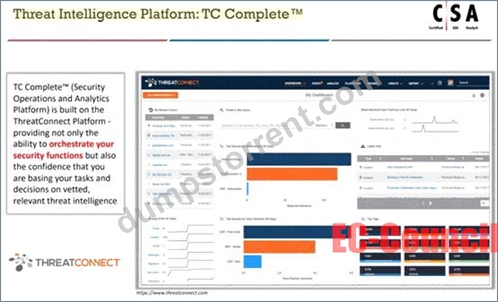
NEW QUESTION # 123
Which of the following contains the performance measures, and proper project and time management details?
- A. Incident Response Procedures
- B. Incident Response Process
- C. Incident Response Policy
- D. Incident Response Tactics
Answer: C
Explanation: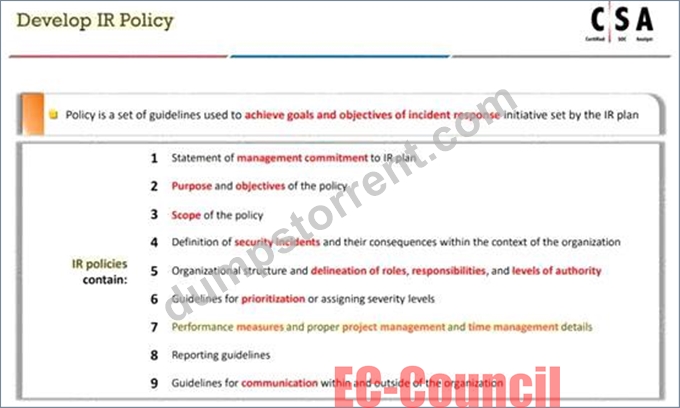
NEW QUESTION # 124
Which of the following attack can be eradicated by using a safe API to avoid the use of the interpreter entirely?
- A. File Injection Attacks
- B. SQL Injection Attacks
- C. Command Injection Attacks
- D. LDAP Injection Attacks
Answer: C
Explanation: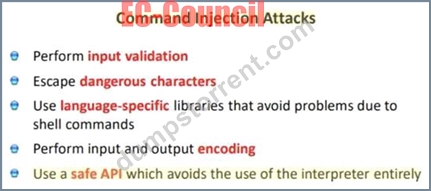
NEW QUESTION # 125
Which of the following factors determine the choice of SIEM architecture?
- A. SMTP Configuration
- B. Network Topology
- C. DHCP Configuration
- D. DNS Configuration
Answer: D
NEW QUESTION # 126
The Syslog message severity levels are labelled from level 0 to level 7.
What does level 0 indicate?
- A. Debugging
- B. Alert
- C. Notification
- D. Emergency
Answer: D
Explanation:
In the Syslog protocol, severity levels are categorized from 0 to 7, with level 0 being the most severe. Level 0 indicates an "Emergency" situation which means the system is unusable. This level of severity is used for the most critical messages, often indicating a complete service or system shutdown.
References:
* EC-Council's Certified SOC Analyst (CSA) course materials, which cover the Syslog severity levels as part of the training1.
* InfraExam 2024, Certified SOC Analyst Part 01, which includes details on Syslog severity levels2.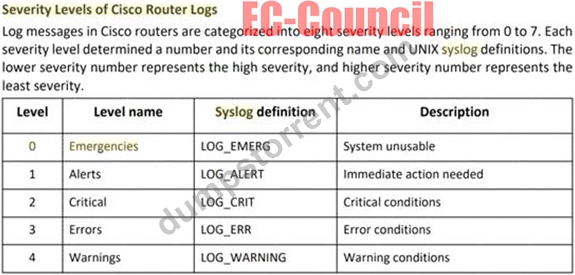
NEW QUESTION # 127
Daniel is a member of an IRT, which was started recently in a company named Mesh Tech. He wanted to find the purpose and scope of the planned incident response capabilities.
What is he looking for?
- A. Incident Response Intelligence
- B. Incident Response Resources
- C. Incident Response Vision
- D. Incident Response Mission
Answer: D
Explanation:
Daniel is seeking to understand the Incident Response Mission, which outlines the purpose and scope of the incident response capabilities within his organization. The mission statement typically defines the primary objectives and the intended direction for the incident response team (IRT). It serves as a guiding principle for the IRT's operations, helping to align their activities with the broader goals of the organization's security posture.
References: The EC-Council's Certified SOC Analyst (CSA) program provides extensive knowledge on SOC operations, including the fundamentals of incident response. The CSA certification emphasizes the importance of understanding the mission of incident response as part of a SOC analyst's role1. Additionally, EC-Council's resources on incident response highlight the significance of having a clear mission to guide the incident handling process2.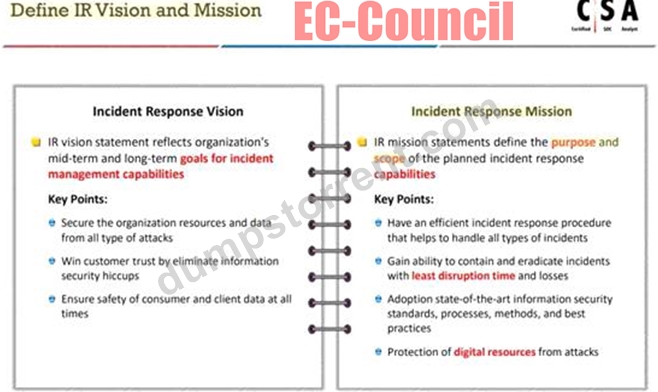
NEW QUESTION # 128
Identify the password cracking attempt involving a precomputed dictionary of plaintext passwords and their corresponding hash values to crack the password.
- A. Syllable Attack
- B. Rainbow Table Attack
- C. Dictionary Attack
- D. Bruteforce Attack
Answer: B
Explanation:
A Rainbow Table Attack involves using a precomputed table of hash values for every possible combination of characters for a given password policy. This table, known as a rainbow table, is then used to look up the corresponding plaintext password for a given hash value. The process involves the following steps:
* Precomputation: Generate the rainbow table by computing hash values for all possible password combinations according to the password policy.
* Storage: Store these precomputed hash values in a table, associating each with its plaintext password.
* Lookup: When a hash value is obtained during a password cracking attempt, search the rainbow table for the corresponding plaintext password.
* Match: If a match is found, the plaintext password associated with the hash value is the cracked password.
Rainbow tables are effective because they trade storage space for time, allowing for quicker password cracking compared to brute-force or dictionary attacks, which compute hash values on the fly.
References: The EC-Council's materials on password cracking techniques discuss various methods including dictionary attacks, brute-force attacks, and rainbow table attacks. Specifically, the EC-Council Learning Paths and Skill Packs provide detailed insights into these techniques, emphasizing the use of rainbow tables as a method of cracking passwords by comparing precomputed hash values to those obtained from a system12. Additionally, EC-Council's CyberQ platform offers practical exercises related to password cracking, including the use of rainbow tables2.
NEW QUESTION # 129
What does the HTTP status codes 1XX represents?
- A. Redirection
- B. Client error
- C. Success
- D. Informational message
Answer: D
Explanation:
The HTTP status codes that fall within the range of 1XX represent informational messages. These are provisional responses that indicate the initial part of a request has been received and has not yet been rejected by the server. The server is informing the client that it has received the header of the request and the client should continue to send the request body if it has not already done so. These status codes are used to provide an interim response to the client while the server processes the full request.
References: The EC-Council's Certified SOC Analyst (C|SA) program includes the study of HTTP status codes as part of understanding web server logs and troubleshooting web server issues. The informational responses (1XX status codes) are covered in the curriculum and can be found in the official EC-Council SOC Analyst study guides and courses. The information is also consistent with the standard definitions provided by the Internet Engineering Task Force (IETF) in RFC 9110, as well as other reputable sources such as MDN Web Docs1 and Wikipedia2.
NEW QUESTION # 130
David Reynolds, a SOC analyst at a healthcare organization, is investigating suspicious login attempts flagged by the SIEM. To mitigate brute-force risk on targeted endpoints, he collaborates with IT to implement an automatic account lockout policy that temporarily disables accounts after multiple failed login attempts.
Within the SOC's eradication strategy, which category of measures does this action align with?
- A. Physical security measures
- B. Authentication and authorization measures
- C. Network security measures
- D. Host security measures
Answer: B
Explanation:
Account lockout is an identity control that directly strengthens authentication by limiting repeated password guessing attempts. It sits within authentication and authorization measures because it governs how accounts can authenticate and how access is granted or denied based on login outcomes. In SOC terms, brute-force attacks target the authentication surface; lockout policies reduce attacker attempts and can prevent successful compromise by forcing a pause or administrative intervention after repeated failures. While the policy may be implemented on hosts or via directory services, its purpose is to control identity access behavior, not network segmentation or physical protections. Host security measures typically refer to endpoint hardening, patching, EDR controls, and local configuration baselines. Network security measures include firewall rules, segmentation, and traffic filtering. Physical security includes facility and device access controls. Because the action is specifically about controlling login attempts and access to accounts, it is best categorized as authentication and authorization. In practice, SOC teams complement lockout policies with MFA, conditional access, password spraying detection, and monitoring for "failures followed by success" patterns to reduce both brute-force success and user disruption.
NEW QUESTION # 131
What is the process of monitoring and capturing all data packets passing through a given network using different tools?
- A. DNS Footprinting
- B. Network Sniffing
- C. Port Scanning
- D. Network Scanning
Answer: B
Explanation:
Networksniffing is the process of monitoring and capturing all data packets passing through a given network.
This is typically done using specialized software or hardware tools designed for this purpose. Here's a detailed explanation of the process:
* Monitoring Traffic: Network sniffing involves using a tool to monitor the data flowing over the network. This can include all types of data packets, regardless of where they come from or where they are going.
* Capturing Packets: The tool captures each packet that passes through the network. This includes the packet's header, which contains information about the packet's source, destination, and other metadata, as well as the payload, which is the actual data being transmitted.
* Analysis: Once captured, the packets can be analyzed for various purposes, such as troubleshooting network issues, monitoring network performance, or detecting security threats.
* Tools Used: There are many tools available for network sniffing, with Wireshark being one of the most popular and widely used due to its powerful features and flexibility1.
References: The concept of network sniffing is covered in EC-Council's Certified SOC Analyst (CSA) training and certification program, which includes understanding the use of tools like Wireshark for packet capturing and analysis213.
Please note that while I strive to provide accurate information, it's always best to consult the latest EC- Council SOC Analyst documents and learning resources for the most current and detailed guidance.
Reference: https://www.greycampus.com/opencampus/ethical-hacking/sniffing-and-its-types
NEW QUESTION # 132
Juliea a SOC analyst, while monitoring logs, noticed large TXT, NULL payloads.
What does this indicate?
- A. Concurrent VPN Connections Attempt
- B. Covering Tracks Attempt
- C. DHCP Starvation Attempt
- D. DNS Exfiltration Attempt
Answer: D
Explanation:
Juliea, the SOC analyst, noticed large TXT and NULL payloads in the logs. This is indicative of a DNS exfiltration attempt. DNS exfiltration is a type of cyber attack where an attacker uses the DNS protocol to sneak data out of a network undetected. It typically involves the use of large TXT records, which can be used to carry data out of the network. NULL payloads can be used in this context to pad the DNS queries and make them less suspicious or to bypass security controls that inspect the content of DNS queries.
The steps involved in DNS exfiltration include:
* The attacker compromises a system within the target network.
* Malware on the compromised system encodes the data it wants to exfiltrate.
* The encoded data is split into chunks that fit into DNS query sizes.
* These chunks are sent as data in DNS queries or responses, often using TXT records.
* An external attacker-controlled server receives the DNS queries and decodes the data.
References:
* EC-Council's Certified SOC Analyst (CSA) course material and study guides provide detailed information on various types of cyber attacks, including DNS exfiltration.
* Online resources and practice questions for the Certified SOC Analyst (CSA) exam also cover this topic and can be used to verify the answer123.
* Additional information on DNS exfiltration techniques and detection methods can be found in security blogs and articles that discuss the subject in depth456.
NEW QUESTION # 133
Identify the type of attack, an attacker is attempting on www.example.com website.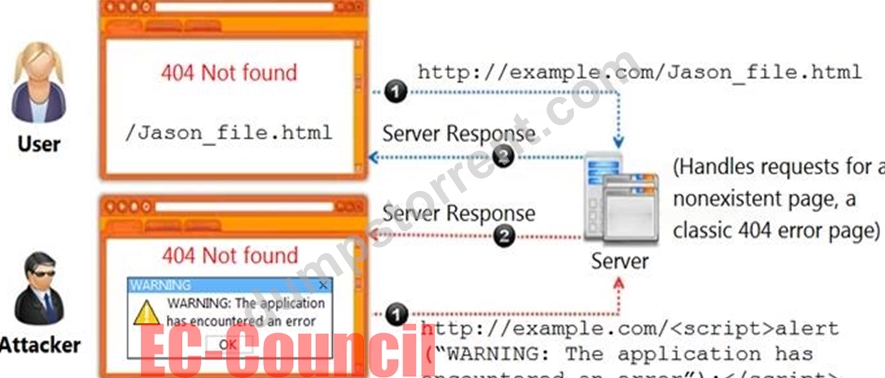
- A. Denial-of-Service Attack
- B. Session Attack
- C. Cross-site Scripting Attack
- D. SQL Injection Attack
Answer: C
NEW QUESTION # 134
The threat intelligence, which will help you, understand adversary intent and make informed decision to ensure appropriate security in alignment with risk.
What kind of threat intelligence described above?
- A. Functional Threat Intelligence
- B. Operational Threat Intelligence
- C. Tactical Threat Intelligence
- D. Strategic Threat Intelligence
Answer: D
Explanation:
The type of threat intelligence that helps in understanding adversary intent and making informed decisions to ensure appropriate security in alignment with risk is known as Strategic Threat Intelligence. This form of intelligence is concerned with the broader goals and motivations of threat actors, as well as the long-term trends and implications of their activities. It provides insights into the cyber threat landscape and helps organizations shape their security strategy and policies to mitigate risks.
Strategic Threat Intelligence is used to inform decision-makers about the nature of threats, the potential impact on the organization, and the necessary steps to align security measures with business objectives. It is less technical than Tactical or Operational Threat Intelligence and does not focus on the specific details of attacks or the technical indicators of compromise. Instead, it provides a high-level view of the threats and their relevance to the organization's risk management.
References: The information provided aligns with the EC-Council's Certified Threat Intelligence Analyst (C|TIA) program, which covers the use of threat intelligence in SOC operations and the integration of threat intelligence into risk management processes1. Additionally, the distinction between different types of threat intelligence, such as Tactical, Strategic, and Operational, is well-documented in the cybersecurity community and can be found in various threat intelligence resources23.
NEW QUESTION # 135
Which of the following is a report writing tool that will help incident handlers to generate efficient reports on detected incidents during incident response process?
- A. threat_note
- B. MagicTree
- C. IntelMQ
- D. Malstrom
Answer: C
NEW QUESTION # 136
Which of the log storage method arranges event logs in the form of a circular buffer?
- A. non-wrapping
- B. wrapping
- C. LIFO
- D. FIFO
Answer: D
NEW QUESTION # 137
Which of the following directory will contain logs related to printer access?
- A. /var/log/cups/Printeraccess_log file
- B. /var/log/cups/accesslog file
- C. /var/log/cups/Printer_log file
- D. /var/log/cups/access_log file
Answer: D
Explanation:
Explanation
Graphical user interface Description automatically generated with low confidence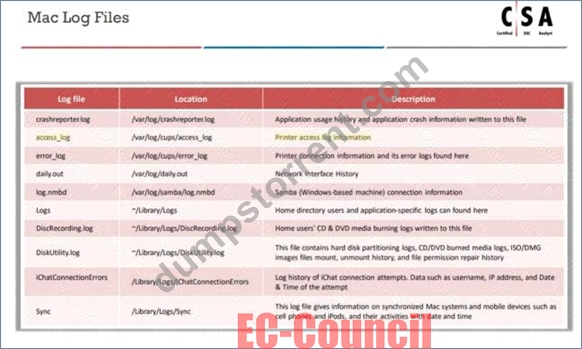
NEW QUESTION # 138
Peter, a SOC analyst with Spade Systems, is monitoring and analyzing the router logs of the company and wanted to check the logs that are generated by access control list numbered 210.
What filter should Peter add to the 'show logging' command to get the required output?
- A. show logging | include 210
- B. show logging | access 210
- C. show logging | forward 210
- D. show logging | route 210
Answer: A
Explanation:
To filter the output of the 'show logging' command to include entries related to a specific access control list, Peter should use the 'include' keyword followed by the access list number. The correct command would be
'show logging | include 210'. This command will display all log entries that contain the string '210', which is the number of the access control list he wants to monitor.
References: The use of the 'include' keyword in Cisco router commands is a standard method for filtering show command outputs to display only lines that contain a specified string or pattern. This is covered in Cisco's documentation and training materials related to router commands and access control list management12.
NEW QUESTION # 139
Which of the following attack can be eradicated by using a safe API to avoid the use of the interpreter entirely?
- A. File Injection Attacks
- B. SQL Injection Attacks
- C. LDAP Injection Attacks
- D. Command Injection Attacks
Answer: B
NEW QUESTION # 140
What does Windows event ID 4740 indicate?
- A. A user account was disabled.
- B. A user account was locked out.
- C. A user account was enabled.
- D. A user account was created.
Answer: B
Explanation:
Event ID 4740 is a security audit event in Windows that indicates a user account has been locked out. This event is generated every time the system locks out a user account due to repeated logon failures, which are typically caused by incorrect password entries. The event is logged on domain controllers, member servers, and workstations where the lockout occurred. It includes details such as the account name, domain, and the computer from which the lockout originated.
References: The information is verified as per Microsoft's official documentation and learning resources related to security auditing and user account management. Specifically, the Microsoft Learn page on security auditing provides comprehensive details on Event ID 47401. Additionally, resources like Ultimate Windows Security offer in-depth explanations of this event and its implications for security monitoring2.
NEW QUESTION # 141
If the SIEM generates the following four alerts at the same time:
I.Firewall blocking traffic from getting into the network alerts
II.SQL injection attempt alerts
III.Data deletion attempt alerts
IV.Brute-force attempt alerts
Which alert should be given least priority as per effective alert triaging?
- A. I
- B. II
- C. III
- D. IV
Answer: A
NEW QUESTION # 142
Which of the following service provides phishing protection and content filtering to manage the Internet experience on and off your network with the acceptable use or compliance policies?
- A. OpenDNS
- B. Apility.io
- C. I-Blocklist
- D. Malstrom
Answer: A
Explanation:
OpenDNS provides extensive phishing protection and content filtering services. It operates by enforcing internet use policies on and off the network, ensuring that users adhere to acceptable use and compliance policies. Here's how OpenDNS achieves this:
* Phishing Protection: OpenDNS uses predictive security to anticipate and prevent threats before they can reach the network. It does this by using DNS to enforce security, which is often quicker and more effective than traditional methods.
* Content Filtering: OpenDNS allows the network administrator to block unwanted content categories, thus enforcing compliance with organizational policies. This is done through DNS queries, which are checked against OpenDNS's database to ensure they comply with the set policies.
* Off-Network Protection: OpenDNS's roaming client allows the same level of protection and filtering even when devices are not connected to the company network, ensuring consistent enforcement of policies.
References:
EC-Council's Certified SOC Analyst (C|SA) program provides training and certification for SOC analysts, covering the fundamentals of SOC operations, including phishing protection and content filtering 1.
Additional resources and study guides from the EC-Council elaborate on the role of SOC analysts and the tools they use, including services like OpenDNS for maintaining network security and integrity 23.
Reference: https://www.spamtitan.com/web-filtering/category/cybersecurity-advice/
NEW QUESTION # 143
......
Latest Questions 312-39 Guide to Prepare Free Practice Tests: https://guidetorrent.dumpstorrent.com/312-39-exam-prep.html